A Printable 2027 Wall Planner: Make Space for What Matters
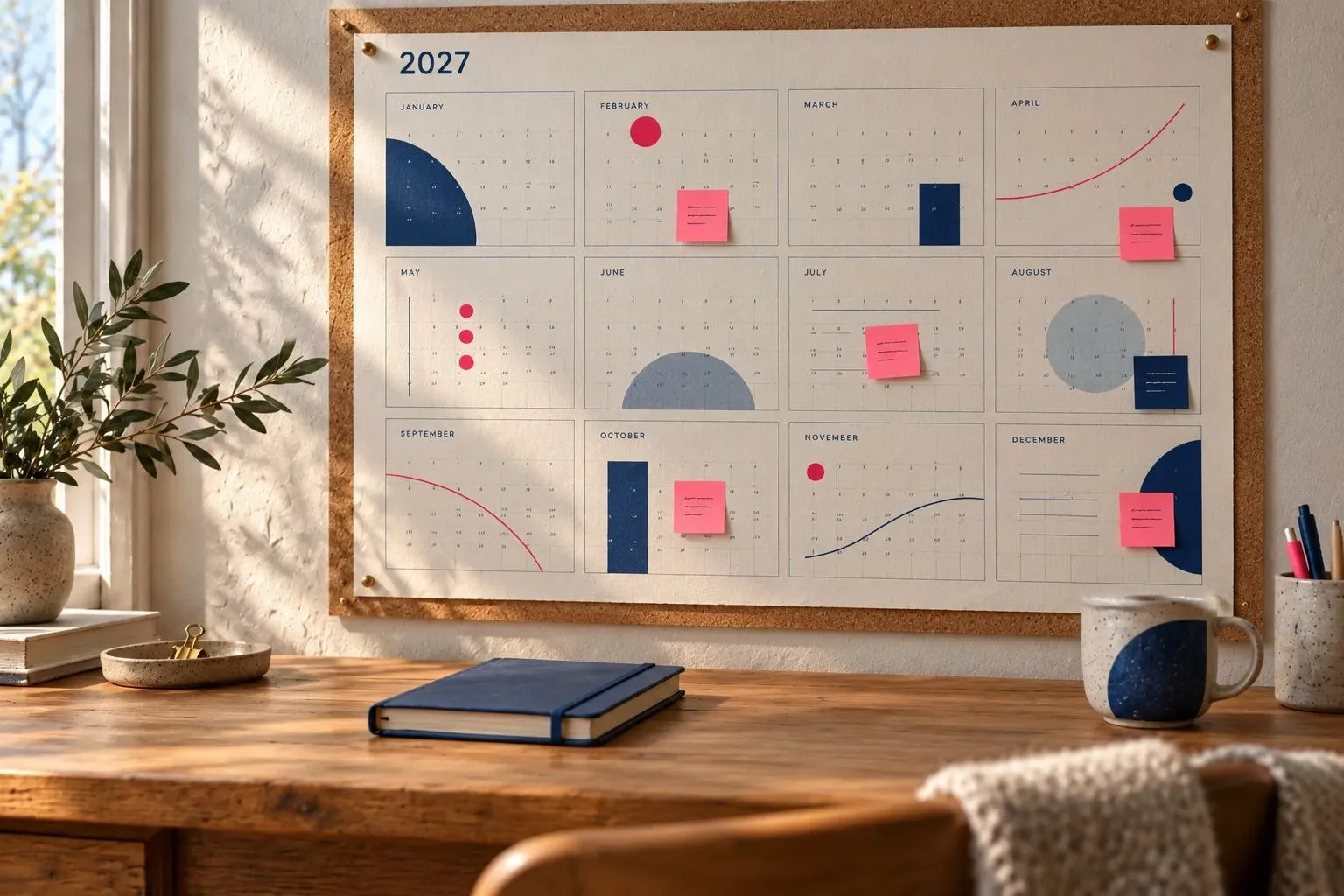
A calendar app can remind you about tomorrow's meeting. A wall planner lets you see the weeks around it: the quiet patch, the crowded month and the deadline that needs work long before the date arrives.
For a small business, a busy household or someone with too many plans in too many places, that wider view is useful. The trick is to make the planner a tool you use, rather than a beautiful sheet you stop noticing by February.
Our free 2027 wall planner is built around that idea: clear dates, useful space and a design that makes sense on paper. Download the one-page A4 landscape PDF here: https://drive.google.com/file/d/1AxZSOHtGl76kfgb0YiwJziNXrkqB7yFk/view?usp=drivesdk&authuser=printreadydublin%40gmail.com
Print at 100% / Actual size on printer-compatible paper. The Monday-start layout marks Republic of Ireland public holidays and leaves room for short notes. This article explains how to make a year planner work and what to check when printing it at home.
Decide what belongs on the wall
Do not copy every appointment from your phone. A crowded annual planner becomes another thing to decode.
Choose the dates that affect the shape of your year: school breaks, planned leave, major events, campaign launches, renewals and deadlines that need preparation.
Keep detailed daily appointments elsewhere. The wall is for seeing relationships between dates. Are you trying to launch something in the same week as a holiday? Have you left enough time between an event and the next big job?
For a business, mark the day something must be ready, then work backwards to the day you need to start. Those are different dates. Giving both a place on the wall can prevent the familiar surprise of a deadline that was visible all along.
Give colour a job
Four useful colours beat twelve attractive ones.
Choose categories that match your life. For example, blue for work deadlines, green for time off, orange for preparation and red for dates that cannot move. Write a small key beside the planner and use it consistently.
Do not rely on colour alone. Add a short label or a simple symbol so the meaning survives a black-and-white print and remains clear to anyone who finds colours hard to distinguish.
Leave most of the sheet unmarked. Empty space is what lets an important date stand out.
Match the format to the viewing distance
A whole year on one A4 sheet is useful as a compact overview. It does not give you the writing room of a large wall chart.
Before printing, decide whether you want something beside your desk or something several people can read across a room. Small boxes suit symbols and short reminders. Longer notes need more space or a separate monthly sheet.
Do not enlarge a file blindly and assume everything will improve. Check the final size, date legibility and the way you intend to mount it. If your home printer cannot produce the format you need, ask about a larger printed version.
Print one test before the final copy
Open the PDF in a reader that shows the print settings clearly. Select the intended paper size and check the preview before using your good paper.
For this download, select A4 landscape and print at 100% / Actual size. It is a single sheet, not a tiled design. Check the preview: "Fit" and "Actual size" are not interchangeable.
Home printers have different printable areas and paper limits. Check your model's guidance, use the right paper setting and avoid feeding heavy card simply because it feels nicer. For most planning, an ordinary matt sheet is easier to write on than a glossy one.
Print a test in draft quality. Check the outer dates, lines and any notes area. Nothing useful should disappear into a printer margin.
Make it a weekly habit
Put the planner where you already pause: beside your desk, near the kitchen table or at the place where the week's work gets discussed.
Once a week, spend five minutes looking ahead. What is due in the next fortnight? What needs ordering? What can move? What should not be squeezed into an already full week?
Use pencil for plans likely to change. When something changes, remove the old mark instead of adding another layer of arrows. A planner should reduce confusion, not record every abandoned plan.
Start with a ten-minute year review
Start by gathering the dates you already know and dividing them into fixed dates, preparation dates and things you would like to make time for.
Check every date against its original source before transferring it. Avoid guessing school holidays, bank holidays or booking dates from memory.
The best wall planner is not the one with the most decoration. It is the one that helps you notice a clash early, protect a quiet week and give the important things enough room.
Download
Get in touch
If you have a question about your next job, visit our shop on Glasnevin Avenue, Glasnevin, email hello@printready.ie, or call (01) 858 1000.